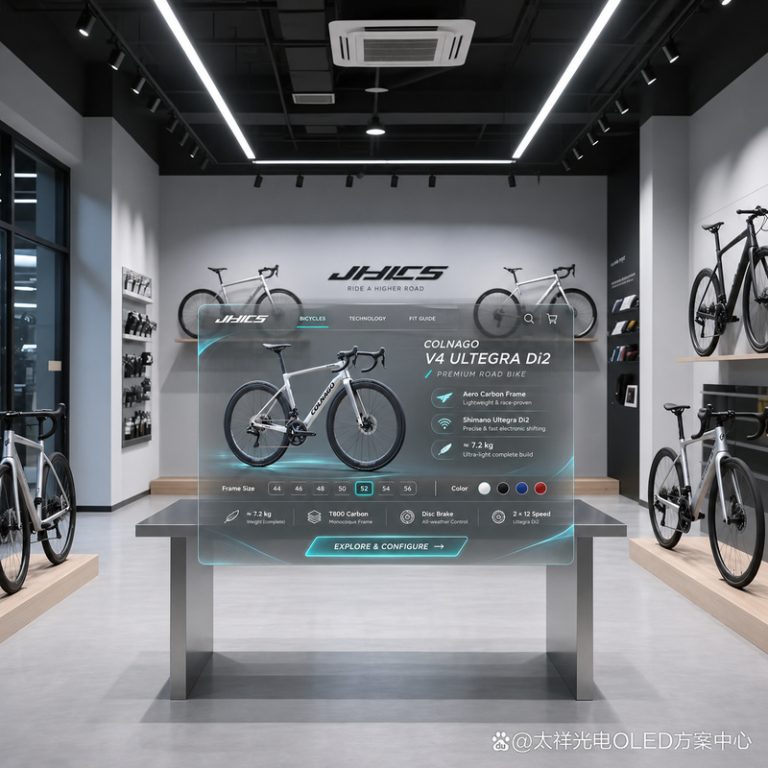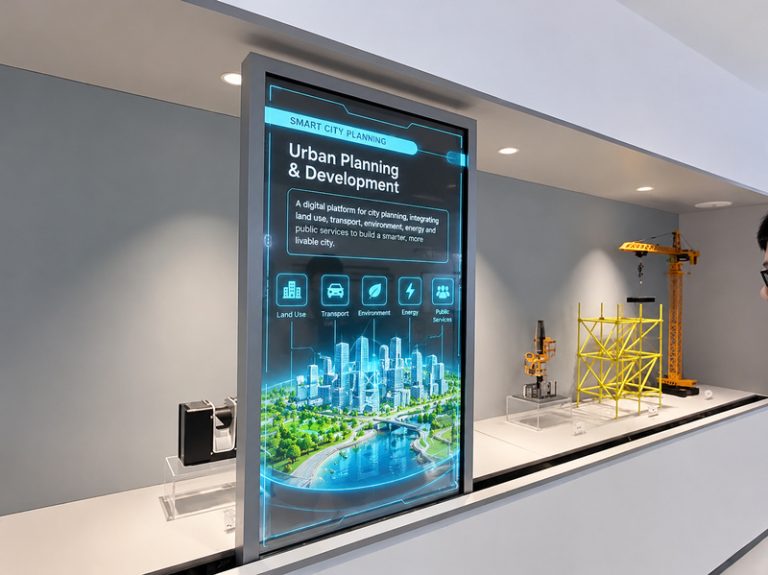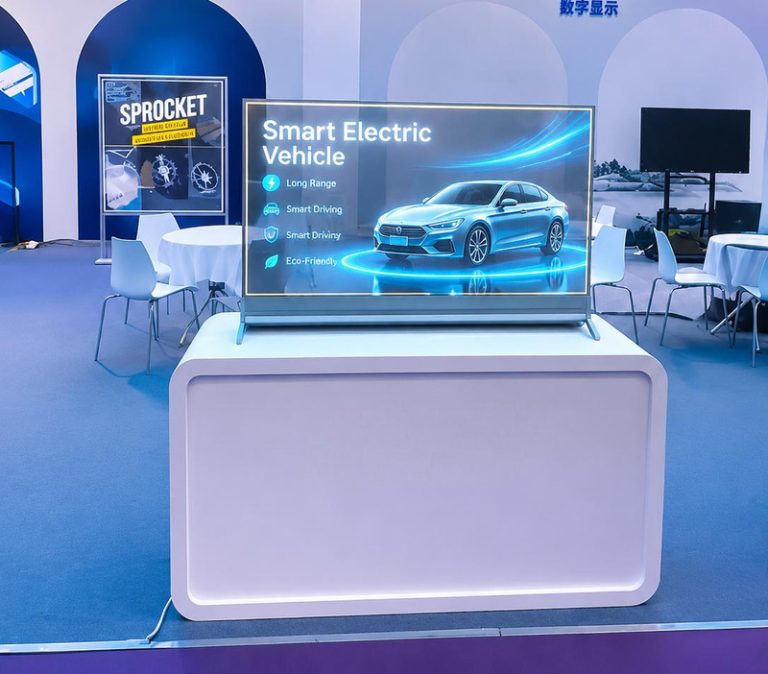

OLED technology has achieved widespread commercial adoption across televisions, smartphones, and professional displays due to its ultra-slim profile, self-emissive architecture, and exceptional color fidelity. With ongoing innovations in transparent display manufacturing, transparent OLED (T-OLED) displays are increasingly deployed across luxury showcase vitrines, retail boutique display windows, and digital corporate exhibition galleries. What distinct competitive advantages do transparent OLED screens offer compared to conventional display technologies?
The Display Principle of Transparent OLED
OLED stands for Organic Light-Emitting Diode. Unlike conventional Liquid Crystal Displays (LCDs) that rely on a separate backlight module to illuminate liquid crystal cells, OLED operates on self-emissive principles: every subpixel independently regulates its own light emission, color, and brightness without requiring an external backlight unit.
From an electronic driving perspective, OLED panels fall primarily into Passive Matrix (PMOLED) and Active Matrix (AMOLED). PMOLED utilizes a simpler matrix structure best suited for small, low-resolution character displays; AMOLED utilizes thin-film transistor (TFT) driving circuitry to govern every individual subpixel independently, enabling high-resolution rendering, fluid video playback, and rich color gradations.
Transparent OLED panels optimize this architecture: deploying transparent conductive electrodes, clear optical glass substrates, and micro-patterned transparent aperture windows within every pixel, the panel renders high-definition graphics while allowing ambient light and physical objects behind the screen to remain clearly visible.
Core Advantages of Transparent OLED Screens
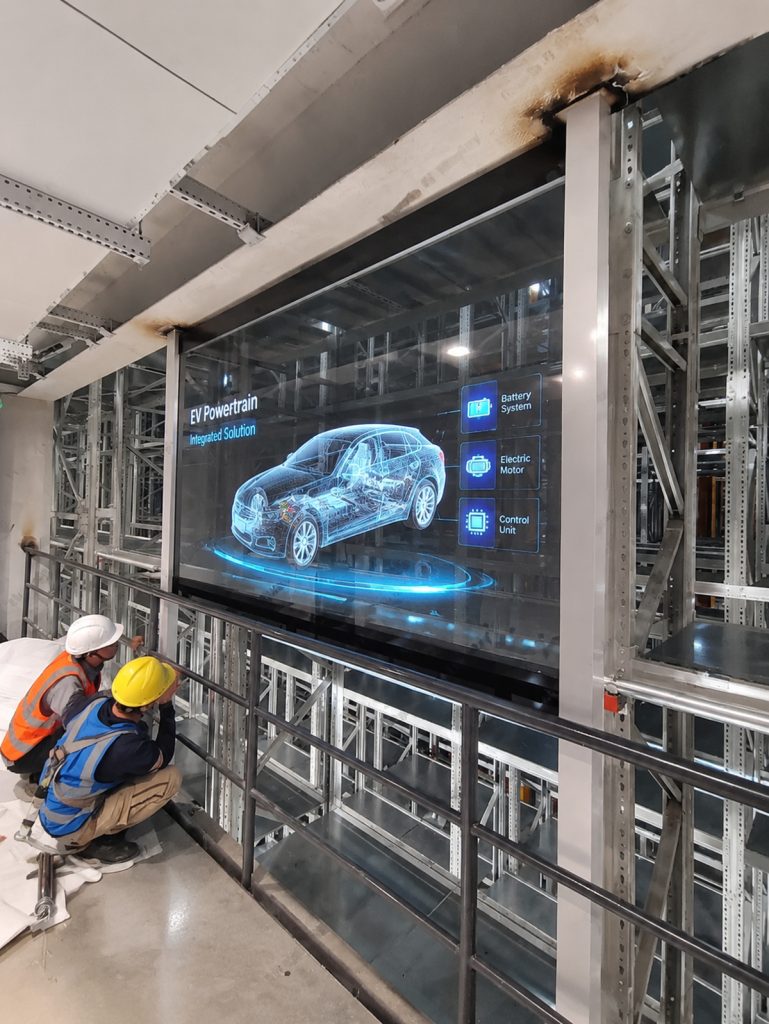
Ultra-Slim Profile and Superior Spatial Integration: Eliminating the bulky LED backlight modules, light guides, and diffusers required by conventional LCDs allows transparent OLED panels to achieve paper-thin profiles. For transparent museum showcases, retail vitrines, and creative architectural installations, this slim profile streamlines enclosure engineering while preventing displays from obstructing physical merchandise.
Self-Emissive Visuals with Outstanding Contrast: Because OLED subpixels emit light independently, the display achieves exceptional dynamic contrast, vibrant color saturation, and lifelike photographic fidelity. When displaying dark content, subpixels turn off completely; the lack of backlight glow renders deep, transparent blacks, giving floating digital content striking visual depth and holographic realism.
Ultra-Wide Viewing Angles for Natural Visual Immersion: OLED displays provide expansive 178-degree viewing angles. When viewed from oblique angles, content maintains stable color accuracy, brightness, and contrast without the color shifting or gamma wash-out typical of lower-tier LCDs—vital for retail windows and exhibitions where audiences view screens from diverse perspectives.
Rapid Response Times for Fluid Motion Playback: OLED subpixels switch states almost instantaneously (measured in microseconds). When rendering high-speed promotional video, 3D product animations, and interactive touch graphics, the screen eliminates motion trailing and ghosting artifacts, ensuring sharp, fluid motion rendering.
Versatile Structural Integration: OLED technology adapts to diverse substrate configurations, enabling ultra-thin, frameless, and curved form factors. Transparent OLED merges visual broadcasting with architectural spatial openness, integrating effortlessly into retail display cases, luxury glass partitions, and creative art installations.

Operational Factors to Consider in Real-World Deployments
While transparent OLED offers compelling advantages, it is not universally superior to LCD or LED across every commercial scenario. Project planners must balance transparency, peak luminance, resolution, and operating lifespan. In sunlit or intensely illuminated environments, whether display luminance is sufficient and whether the background washes out displayed content directly dictate readability.
Furthermore, organic emissive materials, vacuum deposition processes, and precision encapsulation increase panel costs and require disciplined thermal and moisture protection. For displays operating continuously or in demanding commercial environments, operators must ensure proper convective cooling, ingress protection, temperature calibration, and dynamic media scheduling to prevent image retention.
In conclusion, the core commercial value of transparent OLED displays lies in merging high-fidelity visual presentation with spatial see-through transparency. It represents not merely an advanced display technology, but an innovative architectural medium for commercial retail, digital museums, and smart spaces. Project selection should synthesize site lighting, content format, and capital budget to determine whether transparent OLED represents the ideal solution for your application.