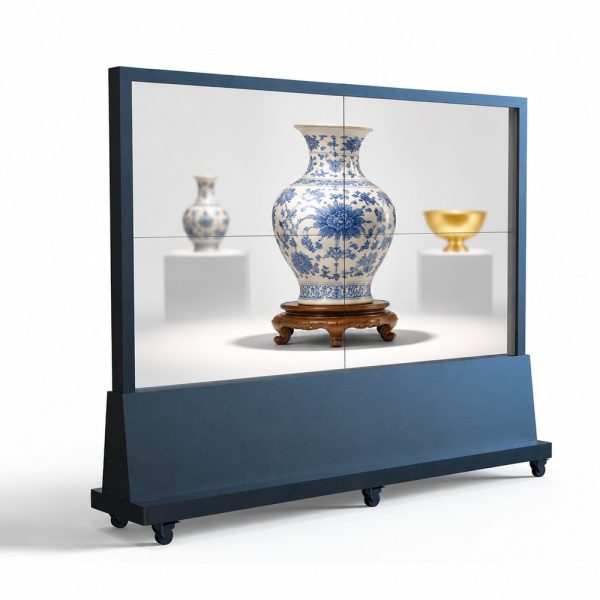
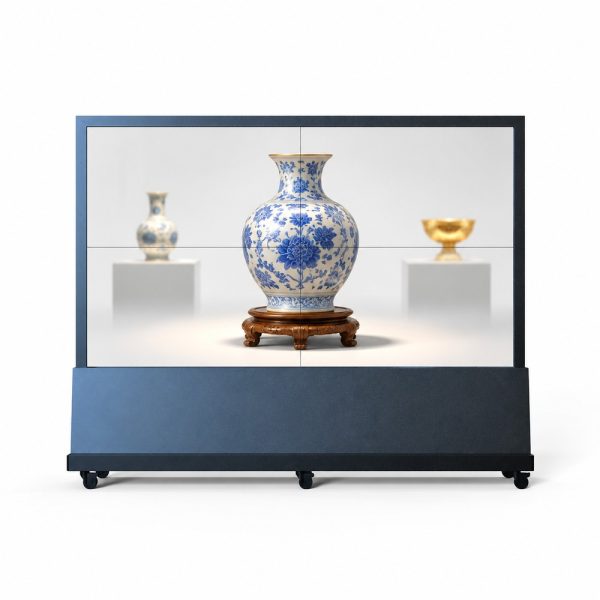
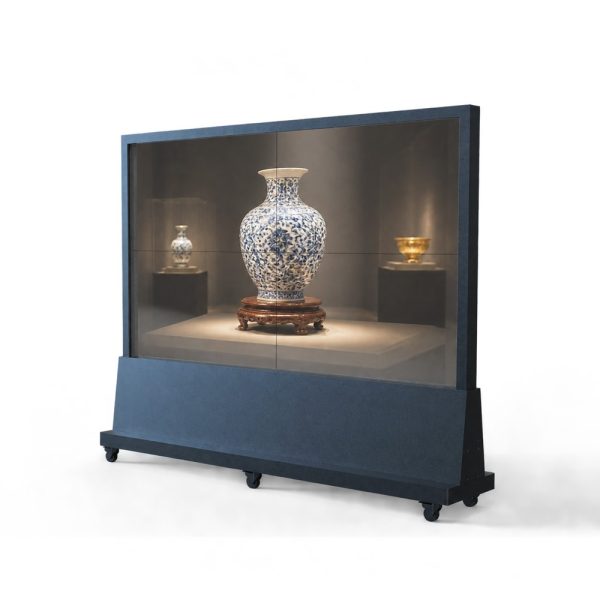


An exhibit’s significance extends beyond its appearance into craftsmanship, history, and detail. A Transparent OLED video wall system arranged in a 2×2 layout provides a larger presentation area for complete images, close-ups, and supporting information.
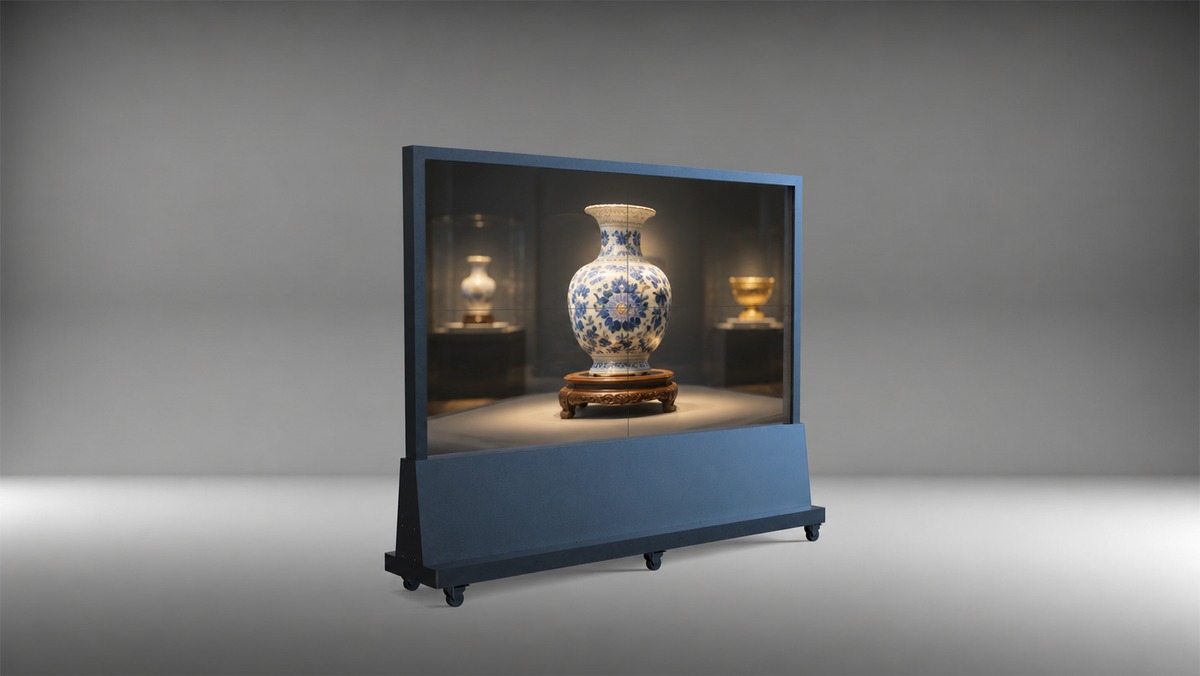
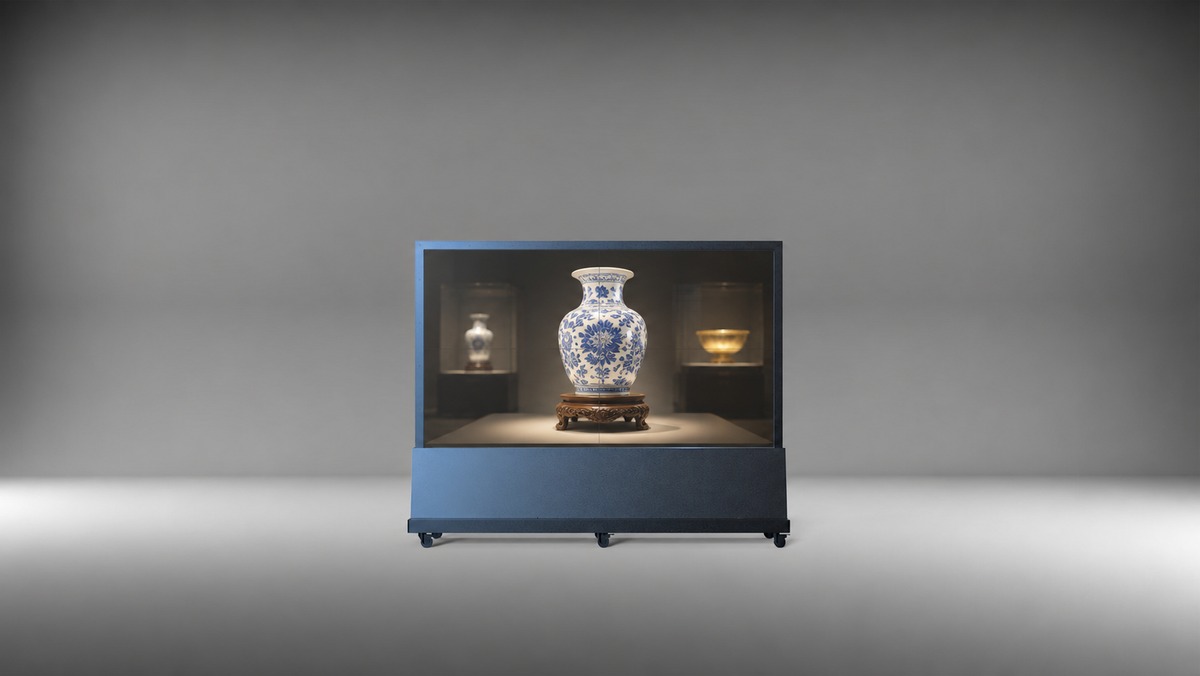
The supplied folder identifies this design as a sliding-rail configuration using 55-inch units. Its rendering shows a dark outer frame, a broad lower enclosure, and a caster-equipped base, creating a defined presentation structure for showrooms and themed exhibitions.
Move Between a Complete Image and Four Content Areas
An opening sequence can introduce the complete subject. Later chapters can assign different areas to decoration, materials, production, and background information.
A porcelain presentation, for example, could begin with the full vessel before exploring its rim, body pattern, and base markings. Short explanations can follow the relevant detail rather than competing with the entire image.
Content for the Transparent OLED video wall system can be planned as one large canvas or as separate zones. Output mapping, synchronized playback, and control capabilities require confirmation against the selected equipment and software.
Compose Around the Panel Boundaries
Horizontal and vertical divisions are visible in the rendering. Faces, important text, and fine annotations should be positioned with those boundaries in mind.
For a full-object image, establish the subject’s position before placing headings and supporting graphics. For zoned presentations, individual panels can carry separate information, making the layout part of the narrative.
The Transparent OLED video wall system should not be described as seamless on the basis of a rendering. Bezel dimensions, panel gaps, and brightness and color matching need verified specifications and sample evaluation.
Coordinate Digital Foregrounds with Physical Exhibits
Where physical objects will sit behind the panels, develop the composition from the main viewing position. Animation can introduce an outline, detail imagery can explain craftsmanship, and reserved areas can preserve a view of the object.
The appearance of a Transparent OLED video wall system depends on rear lighting, displayed content, and ambient brightness. Digital and physical elements occupy different planes, so their apparent alignment changes as visitors move. Precisely aligned labels require on-site calibration.
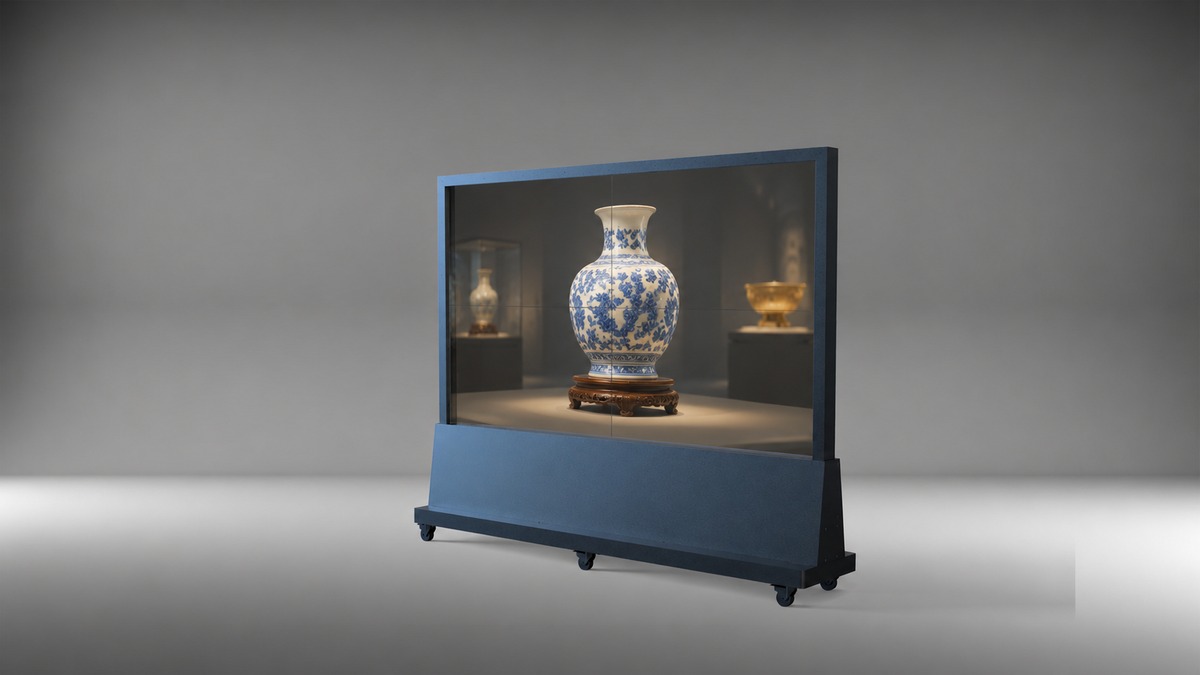
The porcelain scene is illustrative. It does not establish an included enclosed showcase, exhibit lighting, or conservation facilities.
A Dark Frame Defines the Installation
The outer enclosure brings the four units into a single outline, with the lower housing acting as a visual base. Casters are visible, but load capacity, locking arrangements, and handling procedures require confirmation.
The sliding-rail designation also needs supporting documentation. Travel direction, intended purpose, and any motorized control cannot be established from the current rendering.
Frequently Asked Questions
Can one image span all four panels?This can be specified as a requirement. Confirm output mapping, resolution, and synchronization with the control-system supplier.
Can each panel show different content?Independent zones can be included in the application brief. Implementation depends on the playback and control platform.
Do the rails provide automatic opening and closing?The supplied image does not confirm this. Rail construction, travel, drive method, and controls need verification.
Do four panels automatically create a 4K display?No. The total pixel count of the Transparent OLED video wall system depends on each panel’s native resolution and arrangement. Input formats and delivered output must also be checked separately.
Can it be used around heritage objects?It can form the digital-display portion of an exhibition. Enclosure sealing, environmental control, lighting, and security require separately specified facilities.