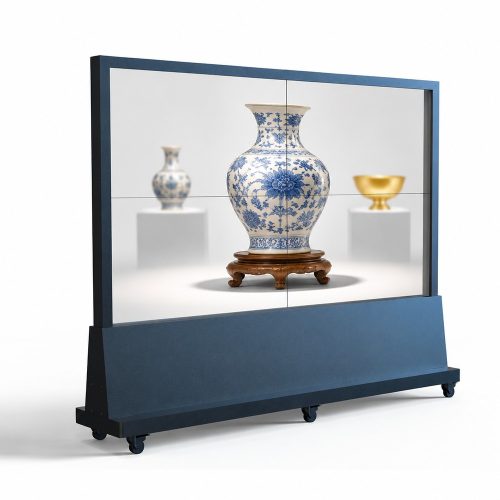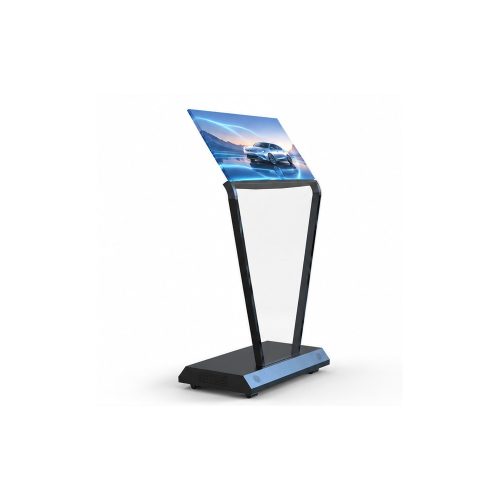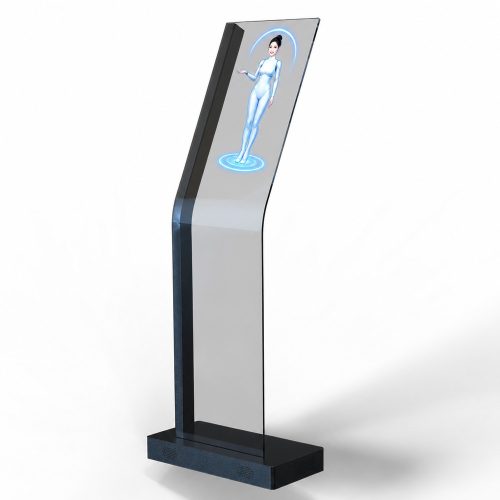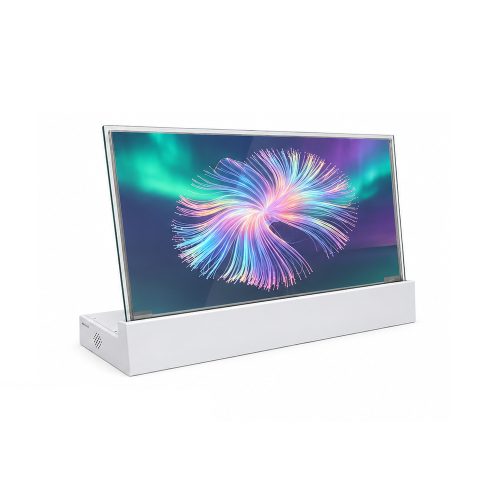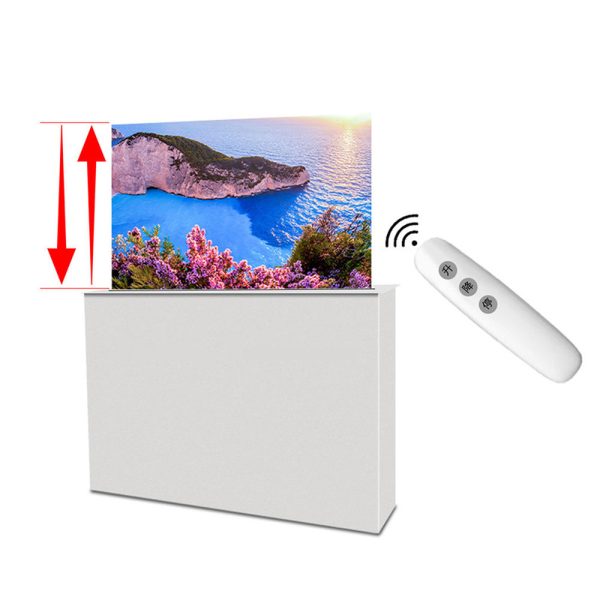
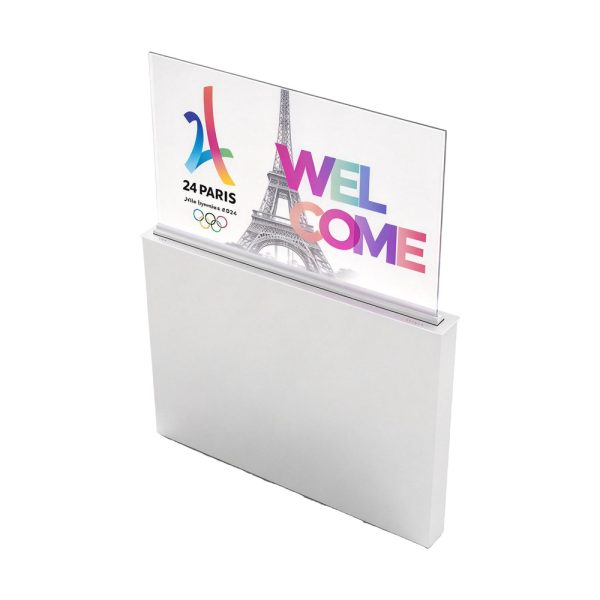
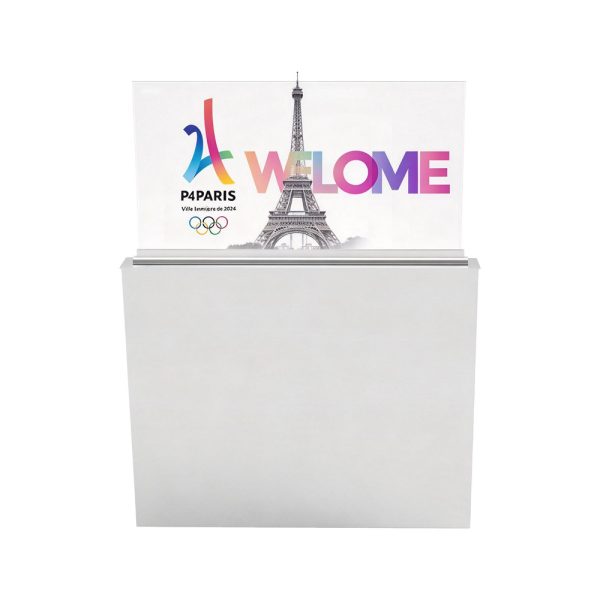
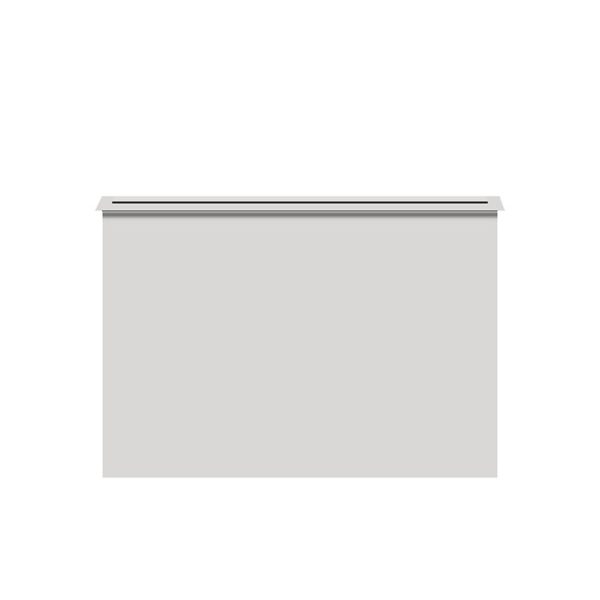
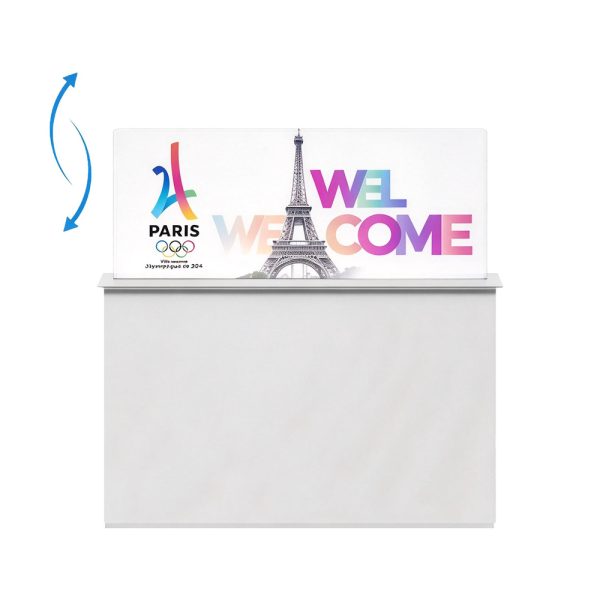

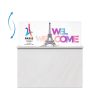
An old suitcase sits on a plinth. Its handle has been polished by years of use, and several faded railway labels still cling to the lid. Those details can hold a visitor’s attention on their own. Once visitors learn where one of the labels came from and which cities the suitcase passed through, they have a reason to look again. Our 30-inch lift-up transparent OLED display gives museums and brand archives two ways to present the same object. With the screen lowered, visitors have a direct view of the artifact. When it rises, maps, archival photographs, and captions can enter the same field of view while the suitcase remains visible behind the graphics.
Picture the plinth at the point where a gallery moves from domestic objects to the history of travel. From an angle, visitors can see the depth of the case, the reinforced corners, and the worn handle. At the front, they can pause to read the exhibit label. At first glance, the overlapping railway stickers might look like ordinary signs of age. When a guided tour reaches the piece, the display rises in front of it. An archival close-up of one sticker appears on one side of the screen, and its city lights up on the other. Visitors can look through the screen to find the original label, recognize a torn corner, and see how far that one piece of luggage may have traveled.
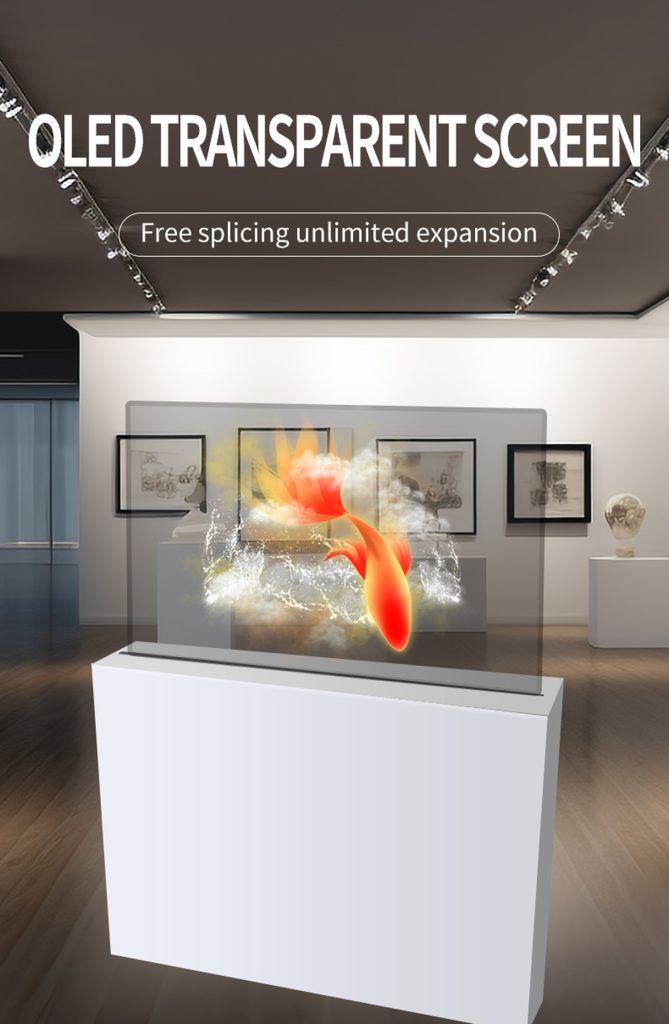
A railway journey unfolds in front of the suitcase
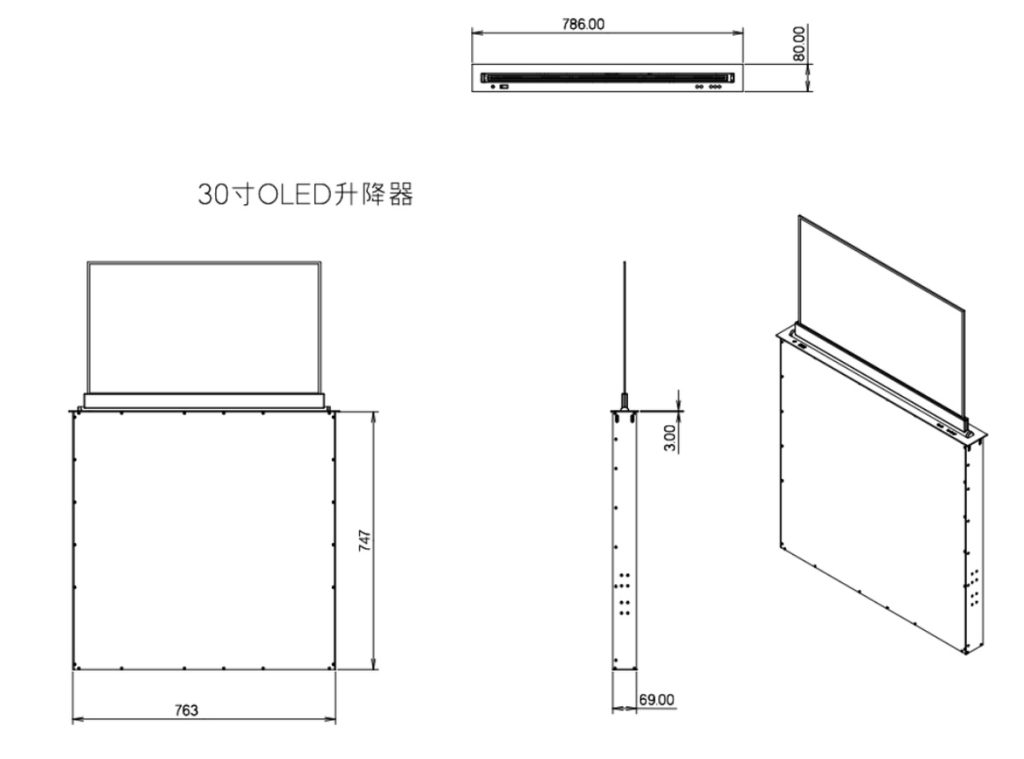
The lift-up transparent OLED display has a 16:9 landscape format and an active display area of approximately 664.3 × 373.5 mm. That width gives a route room to run across several cities while keeping space open around the artifact. Stations can appear in sequence above the lid, with a photograph briefly shown to one side. Visitors can still see the clasps, stitching, and paper labels through the areas left clear. For a label whose lettering has almost faded, the screen can show an enlarged station name alongside a translation. Visitors can read the name and then look for the surviving letters on the original.
The 60 Hz refresh rate supports moving route graphics and transitions between maps, photographs, and captions. An HDMI input connects the screen to an external media player, so the same installation can present different sequences throughout the exhibition. During regular opening hours, a short loop might connect three stations to the suitcase. On a guided tour, the sequence can hold on a period photograph while the guide points out a luggage rack and invites visitors to examine the worn part of the case in front of them. In both settings, the digital material gives people a specific detail to look for on the artifact itself.
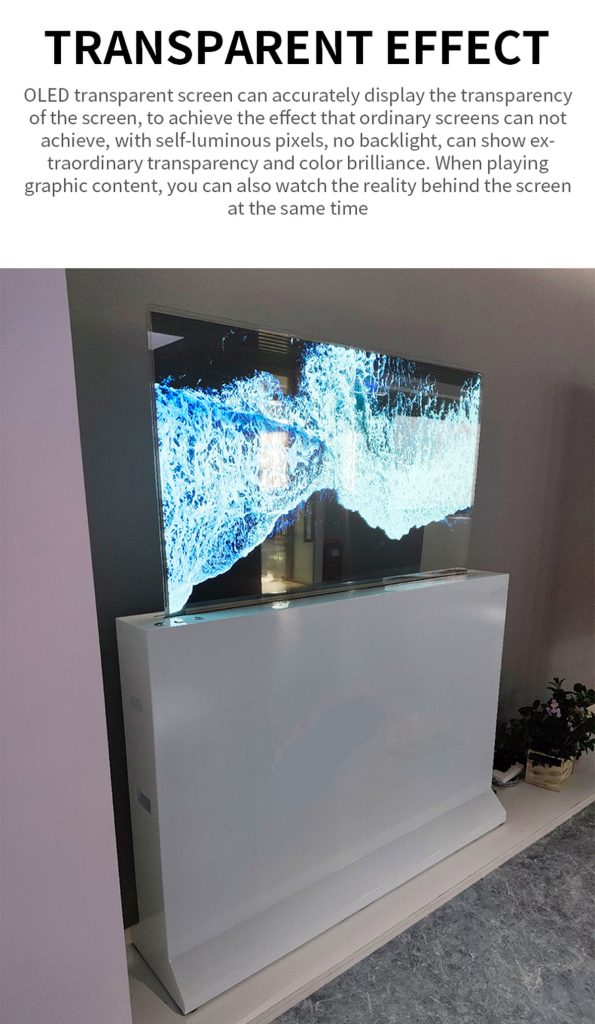
After the story, there’s more to see
The lift mechanism matters at the end of the sequence, too. As the route fades and the screen lowers, visitors have a direct view of the whole suitcase again. Some may look for the clasp they just saw in an archival photograph. Others may move to the side of the plinth to see how one generation of labels overlaps the next. The exhibit can shift from a shared moment of interpretation to a quieter period of observation. Visitors arriving after the tour can begin with the object and take in its details at their own pace.
In a brand archive, the same approach could pair an original piece of luggage bearing an early company mark with a catalog illustration, campaign photograph, or hand-drawn design. Guests can see how the brand once presented the product and inspect the material, stitching, and mark on the original piece. For a showroom that welcomes customers, journalists, and commercial partners, a single exhibit can support several levels of interest. A brief sequence can give visitors one detail to remember, while an extended presentation can use original imagery to show how the design developed.
If you’re planning an exhibit for a museum, brand archive, or touring collection, contact us for a project quote on the 30-inch lift-up transparent OLED display. Tell us what visitors will see on the plinth and which part of its story you want to bring into view.